
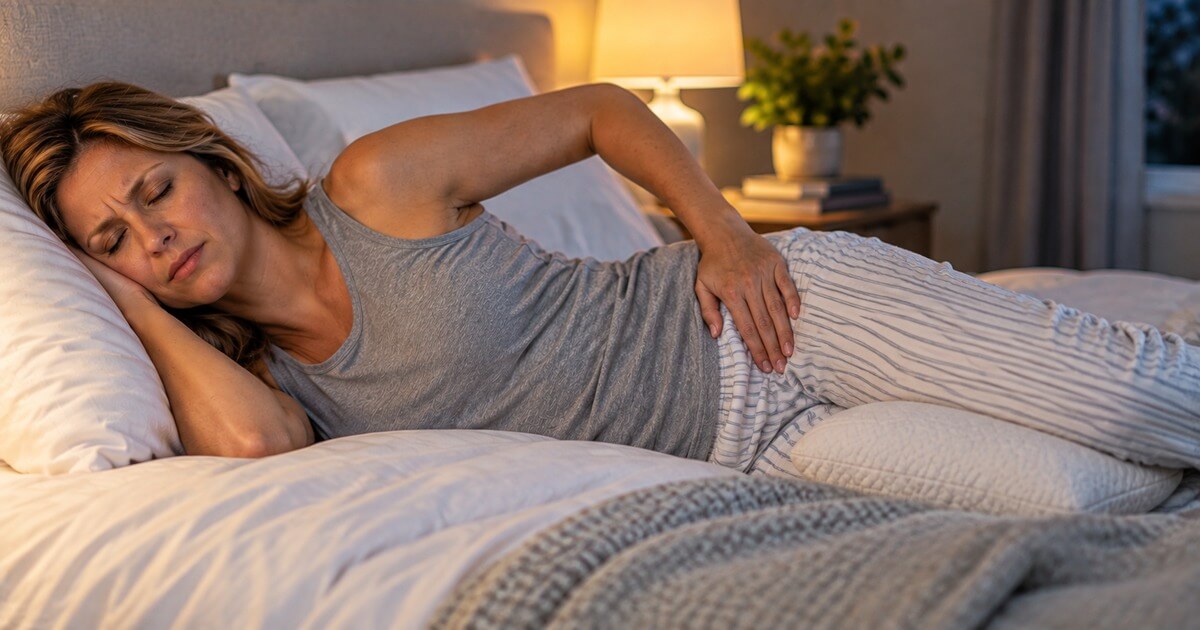
You settle into bed, roll onto your favorite side, and before long your hip starts aching. Or maybe you fall asleep comfortably but wake up during the night because the outside of your hip is sore.
Hip pain while sleeping on your side is common, and there are several reasons it can happen. Sometimes the problem isn’t the hip joint itself. The muscles, tendons, and other tissues surrounding the hip can also become irritated or sensitive to pressure.
Why Side Sleeping Can Make Your Hip Hurt
When you sleep on your side, much of your body weight is concentrated over the outside of the hip that’s against the mattress. That pressure can irritate sensitive tissues around the hip, particularly if you spend several hours in the same position.
Pain on the outside of the hip is sometimes associated with greater trochanteric pain syndrome, a term used for pain involving the tissues around the bony prominence on the side of the hip. The tendons of the gluteal muscles are frequently involved, and the nearby bursa can sometimes become irritated as well.
Your sleeping position can also contribute. If your top leg drops forward or inward while you’re lying on your side, your pelvis may rotate and place additional stress on the hips and lower back.
Could Your Mattress Be Part of the Problem?
Your mattress can influence how much pressure your hip experiences overnight.
A mattress that’s very firm may not provide enough cushioning around the hip and shoulder. On the other hand, a mattress that’s too soft may allow your pelvis to sink excessively, potentially leaving your spine and pelvis in an uncomfortable position.
There isn’t one mattress that’s right for everyone. The goal is a sleep surface that provides enough cushioning to reduce pressure while still supporting your body comfortably.
Try a Pillow Between Your Knees
One of the simplest things to try is placing a pillow between your knees when sleeping on your side.
Without support, the upper leg can fall toward the mattress, causing the pelvis to rotate. A pillow between the knees can help keep the hips, pelvis, and lower back in a more neutral position.
The pillow doesn’t need to be anything special. It simply needs to be thick enough to keep your upper leg comfortably supported.
What If Only One Hip Hurts?
If one hip consistently bothers you, sleeping directly on that side may aggravate already-sensitive tissues.
Try sleeping on the opposite side with a pillow between your knees, or temporarily sleep on your back if that’s comfortable for you. Changing positions throughout the night can also reduce the amount of continuous pressure placed on one area.
The hips, pelvis, and lower back also work together during everyday movement. If you’ve noticed stiffness after sitting for a while, you may also want to read Why Does My Back Hurt When I Stand Up After Sitting?.
Can Chiropractic Care Help?
Because the hips, pelvis, and lower back work together, evaluating how these areas are moving may help identify mechanical factors contributing to discomfort.
At Affinity Chiropractic, Dr. Jane Bigby uses the Activator Method, a gentle, low-force technique that doesn’t require twisting or cracking. You can learn more about chiropractic care at Affinity Chiropractic and how we approach joint mobility and movement concerns.
Depending on what’s causing your symptoms, exercises, changes in sleeping position, or evaluation by another healthcare provider may also be appropriate.
When Should Hip Pain Be Checked?
Occasional soreness after sleeping in an awkward position isn’t unusual. But hip pain that keeps returning, wakes you regularly, becomes progressively worse, or interferes with walking and normal activities deserves further evaluation.
You should also seek medical attention for significant hip pain following an injury, inability to bear weight, fever or significant swelling, or other new or concerning symptoms.
If your hip seems perfectly happy during the day but complains every night when you roll onto your side, your sleeping position may be providing an important clue. A few simple changes — along with determining whether your hips, pelvis, or lower back are contributing — may help you get back to sleeping more comfortably.